Parenting Guide
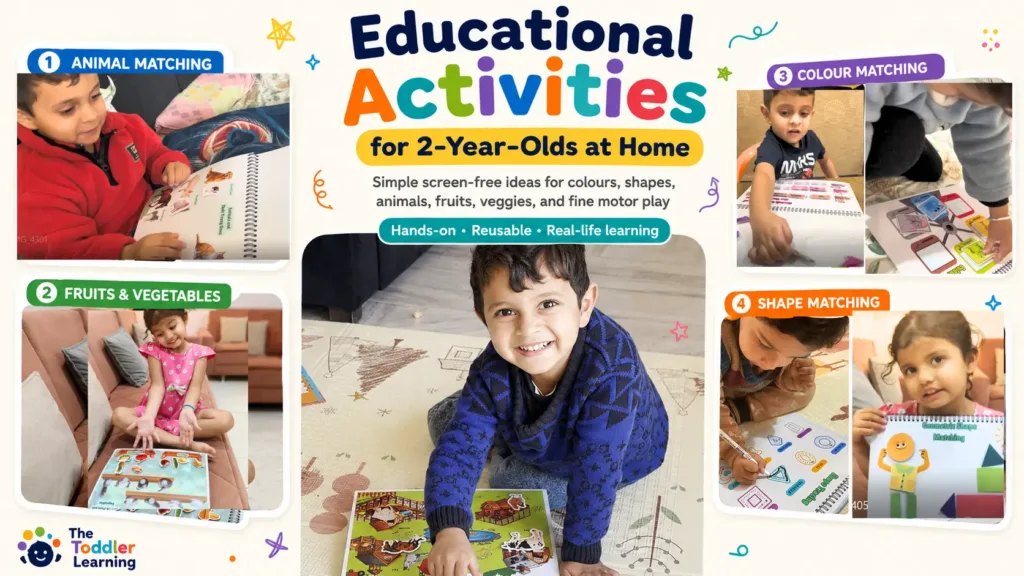
Educational Activities for 2-Year-Olds at Home: Simple Screen-Free Ideas That Build Real Learning
May
Educational Activities for 2-Year-Olds at Home: Simple Screen-Free Ideas That Build Real Learning
You want your 2-year-old to learn, but you may not know where to start. Should you teach colours first? Shapes? Animals? Numbers? Should your toddler be sitting with worksheets? Should they already know fruit names? And how do you keep learning screen-free when your child gets bored after a few minutes?
The best educational activities for 2-year-olds at home are short, hands-on, playful, and connected to real life. At this age, toddlers learn through touching, moving, matching, naming, sorting, pretending, and repeating. They do not need long lessons. They need playful activities they can understand and enjoy.
At 2 years old, many children are starting to point to pictures when asked, say two words together, follow simple directions, use both hands in simple tasks, and play with more than one toy at a time. UNICEF also notes that many 2-year-olds begin sorting shapes and colours, playing simple make-believe games, and following two-step instructions.
That makes this age perfect for simple screen-free activities like animal matching, fruit and vegetable naming, colour sorting, shape matching, Velcro play, pretend cooking, and reusable busy binder activities.
What Should a 2-Year-Old Learn at Home?
A 2-year-old does not need formal lessons. Your goal is not to make your toddler memorise everything quickly.
Your goal is to help them recognise, name, match, sort, and feel confident using words from the world around them.
Here are the best learning areas to focus on at home:
- Vocabulary: Naming animals, fruits, vegetables, colours, shapes, and everyday objects.
- Recognition: Finding a cow, apple, circle, red car, or baby animal when asked.
- Matching: Matching an animal to a scene, a fruit to its slice, or a colour to an object.
- Sorting: Sorting fruits and vegetables, animals by type, or objects by colour.
- Fine motor skills: Peeling, sticking, placing, turning, wiping, and holding pieces.
- Pretend play: Making soup, feeding a friend, parking cars, and caring for animals.
- Listening skills: Following simple directions like “put the banana on the plate.”
- Confidence: Trying again, repeating activities, and celebrating small wins.
Play matters because it supports language, thinking, social skills, problem-solving, and physical development. NAEYC describes play as a central way young children develop language, imagination, peer relationships, physical skills, and problem-solving.
So instead of asking, “How do I teach my toddler?” ask: “How can I turn learning into something my child can touch, move, name, and repeat?”
That is where the real learning happens.
How Long Should Learning Activities Be for a 2-Year-Old?
For most 2-year-olds, 5 to 10 minutes is enough.
Some toddlers may stay with an activity longer if it is hands-on. Others may do one matching page, walk away, and come back later. That is normal.
A good toddler learning session looks like this:
- Show one simple activity.
- Name the objects slowly.
- Let your child touch and move the pieces.
- Ask one easy question.
- Celebrate the attempt.
- Stop before your child becomes frustrated.
You do not need to finish every page. You do not need perfect answers. Repetition is more important than speed.
Try this rhythm: Name it. Match it. Say it again. Move on.
For example, you can say: “This is a cow. Can you find the cow? Yes, cow. The cow goes on the farm.”
Simple. Short. Repeated. That is enough.
1. Animal Recognition Activities
Animals are one of the easiest learning topics for 2-year-olds because toddlers usually enjoy animal sounds, animal pictures, and animal pretend play.
Start with familiar animals first.
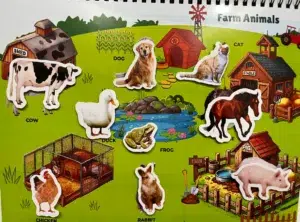
Farm Animal Activity
Use animals your child may already know:
- Cow
- Dog
- Cat
- Duck
- Horse
- Pig
- Sheep
- Goat
Place a few animal cut-outs on the table. Show a farm scene. Then ask simple questions like:
- “Where does the cow go?”
- “Can you find the duck?”
- “What sound does the dog make?”
- “Where is the horse?”
This builds vocabulary, recognition, listening, and matching.
If you use an animal activity binder with real-image cut-outs, your toddler can physically place each animal into the scene. That makes the activity more active than simply looking at a picture.
Wild Animal Activity
Once your toddler understands familiar animals, introduce wild animals such as:
- Lion
- Tiger
- Bear
- Giraffe
- Zebra
- Elephant
- Deer
- Monkey
- Snake
- Crocodile
Keep the language simple:
- “This is a lion. A lion is a wild animal.”
- “This is a giraffe. It has a long neck.”
- “This is a zebra. It has stripes.”
Do not overload your child with too many animals at once. Choose three or four animals first. Repeat them for a few days.
Aquatic Animal Activity
Aquatic animals are great for building curiosity because they look different from everyday animals.
Try animals such as:
- Fish
- Dolphin
- Shark
- Octopus
- Crab
- Turtle
- Seahorse
- Jellyfish
- Starfish
- Penguin
Place the underwater scene in front of your toddler and say:
- “Let’s put the fish in the water.”
- “Can you find the turtle?”
- “Where is the shark?”
This helps your child understand categories: some animals live on farms, some live in the jungle, and some live in water.
Bug Activity
Bugs can be confusing for toddlers if they are mixed into a large animal set. Teach them separately.
Start with:
- Butterfly
- Bee
- Ant
- Ladybug
- Spider
- Caterpillar
- Grasshopper
- Fly
Say simple sentences like:
- “This is a bee.”
- “This is a butterfly.”
- “This is an ant.”
Then ask your child to match or point.
Animal Homes and Baby Animals
This is where animal learning becomes deeper. You can teach:
- Dog and kennel
- Horse and stable
- Hen and coop
- Pig and pigsty
- Bird and nest
- Spider and web
- Rabbit and burrow
- Cow and calf
- Cat and kitten
- Dog and puppy
- Sheep and lamb
- Horse and foal
Try asking:
- “Where does the bird live?”
- “Can you match the baby cow to the cow?”
- “Who lives in the web?”
This builds vocabulary and early classification skills.
Explore the Animal Learning Through Play binder to help your toddler match farm animals, wild animals, aquatic animals, bugs, animal homes, and baby animals using real-image pieces.
2. Fruits and Vegetables Activities
Food-based learning works well because toddlers see fruits and vegetables in real life.
They see bananas at breakfast. They see carrots in the kitchen. They see apples in lunch boxes. That makes the words meaningful.
UNICEF recommends involving toddlers in everyday routines like sorting clothes or serving food because these simple tasks build independence and self-esteem. Fruits and vegetables activities use the same idea: learning through daily life.
Match and Name Fruits
Start with fruits your child sees often:
- Apple
- Banana
- Orange
- Mango
- Strawberry
- Grapes
- Kiwi
- Papaya
Hold up one fruit image and say:
- “This is a banana.”
- “Can you find the banana?”
- “Banana is yellow.”
Then repeat. Do not rush to test your child. Naming comes before answering.
Match and Name Vegetables
Use familiar vegetables such as:
- Potato
- Onion
- Peas
- Tomato
- Spinach
- Beetroot
- Capsicum
- Lady finger
Say:
- “This is a tomato.”
- “Tomato is red.”
- “Can you put a tomato in the basket?”
This builds vocabulary and category awareness.
Make Pretend Fruit Salad
Pretend food activities are powerful because toddlers love copying adult routines.
Try this:
- Give your child fruit cut-outs.
- Place a bowl or plate in front of them.
- Say, “Let’s make fruit salad.”
- Ask them to add one fruit at a time.
- Name each fruit as you place it.
For example:
- “Add banana.”
- “Add apple.”
- “Add strawberry.”
- “Yum, fruit salad!”
This builds pretend play, vocabulary, and listening.
Make Pretend Vegetable Soup
Use vegetable cut-outs and a pot image or a real bowl.
Say:
- “Let’s make vegetable soup.”
- “Put the carrot in.”
- “Add tomato.”
- “Stir, stir, stir.”
This turns food vocabulary into an action. Your toddler is not just hearing the word. They are using it in play.
Match Whole Fruits With Sliced Fruits
This is a strong activity because toddlers often see fruit in different forms.
An apple can be whole. It can also be sliced. A banana can be whole. It can also be peeled or cut.
Try:
- “Here is the apple. Where is the apple slice?”
- “Here is the kiwi. Can you find the inside of the kiwi?”
This builds visual discrimination and real-world understanding.
Sort Fruits and Vegetables
Use two baskets: one for fruits and one for vegetables.
Give your toddler two or three pieces at a time and say:
- “Apple goes in fruits.”
- “Potato goes in vegetables.”
- “Where should the tomato go?”
At age 2, your child may not always sort correctly. That is fine. The repetition matters.
CTA: Make food vocabulary easier with the Fruits & Veggies Learning Through Play binder, especially for pretend fruit salad, vegetable soup, slice matching, root vegetable scenes, and sorting activities.
3. Colour Matching Activities
Toddlers often repeat colour names before they fully understand them.
A child may say “red” for everything. That does not mean they are not learning. It means they are still connecting the word to the concept.
The best way to teach colours is to show the same colour in many real objects.
For example, red can be:
- A rose
- A car
- A tomato
- A chilli
- A balloon
- A fish
This is much stronger than showing only a plain red card.
Start With One Colour at a Time
Do not teach every colour in one sitting.
Start with one colour and say: “Today we are finding red things.”
Show three red objects. Then match them.
Once your child understands red, introduce yellow, blue, green, orange, purple, black, white, brown, and pink.
Colour Spinner Activity
A colour spinner turns recognition into a game.
Try this:
- Spin the arrow.
- Name the colour.
- Find an object that matches.
- Place the object in the correct area.
Say: “The spinner landed on yellow. Can you find something yellow?”
This builds attention, colour recognition, and turn-taking.
Colour Train Activity
A colour train is useful because the child can match objects by colour while pretending the train is moving.
Say:
- “The pink train needs pink things.”
- “The purple train needs purple things.”
- “Can you put the butterfly on the purple train?”
This makes colour matching more playful.
Car Parking Colour Match
If your toddler likes vehicles, use that interest.
Say:
- “Park the red car in the red parking space.”
- “Where does the blue car go?”
- “Yellow car goes here.”
This is simple, visual, and satisfying for toddlers.
Ferris Wheel Colour Match
This activity helps toddlers match colour cards to a playful object.
Say:
- “Let’s put the green animal on the green wheel.”
- “Can you find blue?”
The novelty keeps the activity fresh.
Wipe-Clean Colouring
Reusable colouring pages help toddlers practise holding a marker, making lines, and controlling hand movement.
Do not expect neat colouring. At this age, scribbling, wiping, and trying again are all useful.
Try the Colour Learning Through Play binder if your child mixes up colours. Seeing colours through real objects, such as cars, trains, animals, fruits, and wipe-clean pages, helps make colour learning more meaningful.
4. Shape Activities With Real-Life Objects
Many toddlers can repeat the word “circle” or “triangle,” but they may not recognise those shapes in the real world.
That is why real-life object matching is so useful.
A circle is not only a flat drawing. It can be:
- A wheel
- A clock
- A button
- A plate
- A ball
A triangle can be:
- A pizza slice
- A sandwich
- A roof
- A party hat
This helps your toddler understand that shapes exist everywhere.
Start With Four Basic Shapes
Begin with:
- Circle
- Square
- Triangle
- Rectangle
Do not introduce too many shapes at once. Keep it simple.
Match Shapes With Real Objects
Show a triangle. Then show a pizza slice.
Say: “This is a triangle. The pizza slice is also a triangle.”
Then ask: “Can you find another triangle?”
Do the same with:
- Circle and wheel
- Square and cracker
- Rectangle and book
- Triangle and roof
Shape Spinner Activity
A shape spinner makes shape recognition playful.
Say:
- “The spinner landed on a circle.”
- “Can you find the circle?”
- “Put the circle in the jar.”
This builds visual recognition and listening.
Sort by Shape
Use four groups:
- Circles
- Squares
- Triangles
- Rectangles
Give your toddler a small number of objects. Ask them to place each object in the right group.
If they get it wrong, gently model: “This one is a circle. Let’s put it here.”
Create Pictures With Shapes
Shape-building activities help children see how shapes work together.
For example:
- Triangle roof
- Square house
- Circle sun
- Rectangle car body
- Circle wheels
This builds creativity and early problem-solving.
CTA: The Shape Activity Binder is especially useful because it connects shapes with real-life objects. That helps toddlers understand that shapes are not just drawings on a page.
5. Fine Motor Activities for Toddlers
Fine motor skills are the small hand and finger movements children use before writing.
At age 2, your child is building these skills through everyday actions like peeling, grabbing, placing, turning, wiping, scribbling, stacking, and sorting.
CDC notes that many 2-year-olds are learning to use one hand while the other hand does something else, such as holding a container and taking off a lid. That is exactly why hands-on activities are so valuable.
Good fine motor activities include:
- Peeling Velcro pieces
- Sticking pieces in the correct spot
- Turning a spinner
- Holding a wipe-clean marker
- Wiping reusable pages
- Picking up small cut-outs
- Sorting pieces into groups
- Matching objects carefully
Try this simple activity:
- Place three animal pieces in front of your child.
- Ask them to pick up one piece.
- Help them place it in the correct scene.
- Let them press it down.
- Ask them to remove it and try again.
That one activity works on vocabulary, recognition, finger strength, hand-eye coordination, and confidence.
Always supervise activities with small pieces.
6. Pretend Play Learning Activities
Pretend play is not “just playing.” It is one of the best ways toddlers learn language.
Between ages 2 and 3, toddlers begin using growing thinking skills for pretend play, and they learn through familiar routines like feeding, cooking, driving, and caring for toys.
Pretend play gives words a purpose.
Instead of only saying “apple,” your child can:
- Pick up the apple
- Put it on a plate
- Feed it to a friend
- Add it to fruit salad
- Say “yum”
- Repeat the word again
That is meaningful learning.
Pretend Fruit Salad
Say:
- “Let’s make fruit salad.”
- “Add banana.”
- “Add apple.”
- “Mix it.”
- “Who wants to eat?”
Pretend Vegetable Soup
Say:
- “Let’s cook soup.”
- “Put a tomato in.”
- “Add peas.”
- “Stir the soup.”
- “Soup is ready!”
Feed Your Friend
A feeding activity helps toddlers understand where food goes and encourages pretend care.
Say:
- “Feed your friend the banana.”
- “Now give an apple.”
- “Friend is hungry.”
Animal Homes Pretend Play
Use animal homes and say:
- “Dog goes to the kennel.”
- “Bird goes to the nest.”
- “The horse goes to the stable.”
This builds vocabulary and categorisation.
Car Parking Pretend Play
Say:
- “The red car is parked.”
- “Blue car is waiting.”
- “Green car goes next.”
This teaches colour, sequence, and pretend play in one activity.
Responsive back-and-forth interaction also matters. Harvard’s Center on the Developing Child explains that serve-and-return interactions, where a child gestures or communicates and an adult responds with words, eye contact, or action, support early language and social development.
So while your toddler plays, talk with them. Name what they touch. Respond to what they point at. Add one small sentence.
That is how play becomes learning.
7. Screen-Free Quiet-Time Activities
Many parents do not need more complicated crafts. They need activities that work in real life:
- While cooking
- During travel
- At restaurants
- While waiting
- During quiet time
- When reducing screen time
- When a toddler needs independent play
The American Academy of Pediatrics now encourages families to think beyond only screen-time minutes and consider balance, content, co-viewing, and communication. For toddlers, that means screen-free options should be easy to reach, simple to understand, and interesting enough to repeat.
Good screen-free quiet-time activities include:
- Busy binder pages
- Matching activities
- Sorting pages
- Velcro pieces
- Wipe-clean colouring
- Animal scenes
- Fruit and vegetable pretend play
- Colour parking games
- Shape matching pages
A toddler learning binder can help because it keeps several activities in one place. Your child has something to touch, move, match, remove, and repeat.
That is especially helpful when you do not have time to set up a full sensory bin or craft activity.
See all screen-free toddler learning binders if you want reusable activities for animals, fruits and vegetables, colours, shapes, vocabulary, pretend play, and fine motor practice.
How to Choose the Right Educational Activity for Your 2-Year-Old
Use your goal to choose the activity.
- Build vocabulary: Try animals, fruits, vegetables, and real object matching.
- Reduce screen time: Try a busy binder, matching games, and pretend play.
- Improve fine motor skills: Try Velcro pieces, spinners, and reusable marker pages.
- Teach colours: Try colour matching with real images.
- Teach shapes: Try shape sorting and real-life object matching.
- Encourage independent play: Try simple binder pages and matching tasks.
- Support pretend play: Try fruit salad, vegetable soup, feeding, and animal homes.
- Improve attention span: Try short repeatable activities with clear steps.
- Build confidence: Try easy matching activities your child can complete.
Start with your child’s interest.
- If your toddler loves animals, start with animals.
- If they love food, start with fruits and vegetables.
- If they love cars, start with coloured car parking.
- If they love drawing, start with wipe-clean colouring.
Interest creates attention. Attention creates learning.
Common Mistakes Parents Make With Learning Activities
Mistake 1: Making Activities Too Long
A 2-year-old does not need a 30-minute lesson. Short and repeated is better.
Try one activity for 5 minutes. Stop while your child is still enjoying it.
Mistake 2: Teaching Too Many Things at Once
Do not teach animals, colours, numbers, and shapes all at the same time.
Choose one focus:
- “Today we are matching farm animals.”
- “Today we are finding red things.”
- “Today we are sorting fruits.”
Mistake 3: Expecting Perfect Answers
Toddlers learn through repetition. They will get things wrong. That is part of learning.
Instead of saying, “No, that’s wrong,” say: “This one is the cow. Let’s put the cow here.”
Mistake 4: Using Only Abstract Worksheets
Flat worksheets can be difficult for toddlers because they are not always connected to real life.
Real images, real objects, and movable pieces make learning easier to understand.
Mistake 5: Not Repeating Activities Enough
Toddlers need to see the same words and ideas many times.
Repeat the same animal page. Repeat the same colour match. Repeat the same fruit salad game.
Repetition builds confidence.
Mistake 6: Correcting Too Much
The goal is not pressure. The goal is playful learning.
Praise effort:
- “You found the banana.”
- “You matched the red car.”
- “You tried again.”
- “You put the horse on the farm.”
Confidence keeps toddlers engaged.
FAQs
What educational activities can I do with my 2-year-old at home?
The best educational activities for 2-year-olds at home include animal matching, fruit and vegetable naming, colour sorting, shape matching, pretend cooking, Velcro activities, wipe-clean pages, and simple busy binder games. Keep activities short, hands-on, and playful.
What should a 2-year-old be learning?
A 2-year-old can begin learning animal names, fruit and vegetable names, basic colours, basic shapes, matching, sorting, big and small, same and different, simple directions, pretend play, and fine motor control. Every child develops at their own pace, so focus on playful exposure rather than pressure. Read this article by CDC to get milestone checklist describing age-appropriate developmental framing
How long should a 2-year-old do learning activities?
Many 2-year-olds do well with 5 to 10 minutes at a time. Some may continue longer if the activity is hands-on and interesting. Stop before your child becomes frustrated and repeat the activity later.
How do I teach my toddler colours?
Teach one colour at a time. Use real objects, not only colour cards. For example, show red through a red car, red apple, red rose, red balloon, and red fish. Matching activities help toddlers understand colour in a practical way.
How do I teach shapes to toddlers?
Start with circle, square, triangle, and rectangle. Match each shape to real-life objects like a wheel, clock, pizza slice, sandwich, book, or window. This helps toddlers understand that shapes exist in the real world.
Are busy binders good for toddlers?
Busy binders can be helpful for toddlers when they are age-appropriate, supervised, simple, and hands-on. They work best when they include matching, sorting, Velcro pieces, reusable pages, real images, and activities toddlers can repeat.
What are good screen-free activities for 2-year-olds?
Good screen-free activities include animal matching, fruit salad pretend play, vegetable soup play, colour parking games, shape sorting, wipe-clean colouring, puzzle matching, stacking, sorting household objects, and toddler busy binders.
How can I keep my 2-year-old busy while I cook?
Give your toddler a simple activity that does not need much help, such as matching fruits to a plate, sorting vegetables into baskets, placing animals on a farm scene, parking cars by colour, or using a reusable busy binder page nearby. Always supervise closely.
Should 2-year-olds use worksheets?
Traditional worksheets are not necessary for most 2-year-olds. Toddlers usually learn better through hands-on play, movement, real images, matching, sorting, pretend play, and short repeated activities.
Why are real images useful for toddler learning?
Real images help toddlers connect pictures with the world they see every day. A real banana, cow, car, clock, or flower is easier to connect to daily life than a highly abstract cartoon image.
Conclusion
At age 2, learning should feel like play.
You do not need long lessons, complicated prep, or pressure. Start with simple activities your child can touch and understand:
- Match the cow to the farm.
- Add a banana to the fruit salad.
- Park the red car.
- Match the circle to the wheel.
- Put the bird in the nest.
These small activities build vocabulary, recognition, matching, sorting, pretend play, fine motor skills, and confidence.
If you want a simple way to organise screen-free learning at home, start with one toddler learning binder based on your child’s interest: animals, fruits and vegetables, colours, or shapes. Use it for a few minutes a day, repeat favourite pages, and let learning stay playful.
That is how real learning begins.
