Parenting Guide, Uncategorized
Educational Activities for Children at Home by Age 1 to 5
Apr
Educational Activities for Children at Home by Age 1 to 5
Teaching your child at home does not have to feel complicated. You do not need long lessons, a strict schedule, or a school-style setup to help your child learn. In most homes, meaningful educational activities begin with small, daily moments, such as naming things, matching, talking, sorting, noticing patterns, and repeating simple ideas over and over again.
Young children learn best through simple, playful interaction, and UNICEF shares several helpful play based learning ideas for babies and toddlers that support everyday development at home.
This guide is a simple starting point for parents who want to understand age-appropriate educational activities without feeling overwhelmed. Think of it as a gentle home learning path, not a pressure-filled checklist. Every child learns in their own way and at their own pace.
Educational Activities for Children by Age
Why an age-wise approach helps
When parents try to teach everything at once, it often becomes stressful for both the parent and the child. An age-wise approach makes educational activities easier to plan. It helps you focus on what feels most natural, useful, and age appropriate right now.
Instead of asking, “What should my child know already?” it is often better to ask, “What educational activities can I start introducing now in a simple and playful way?”
That one shift changes everything. It makes home learning feel lighter, more practical, and much easier to continue every day.
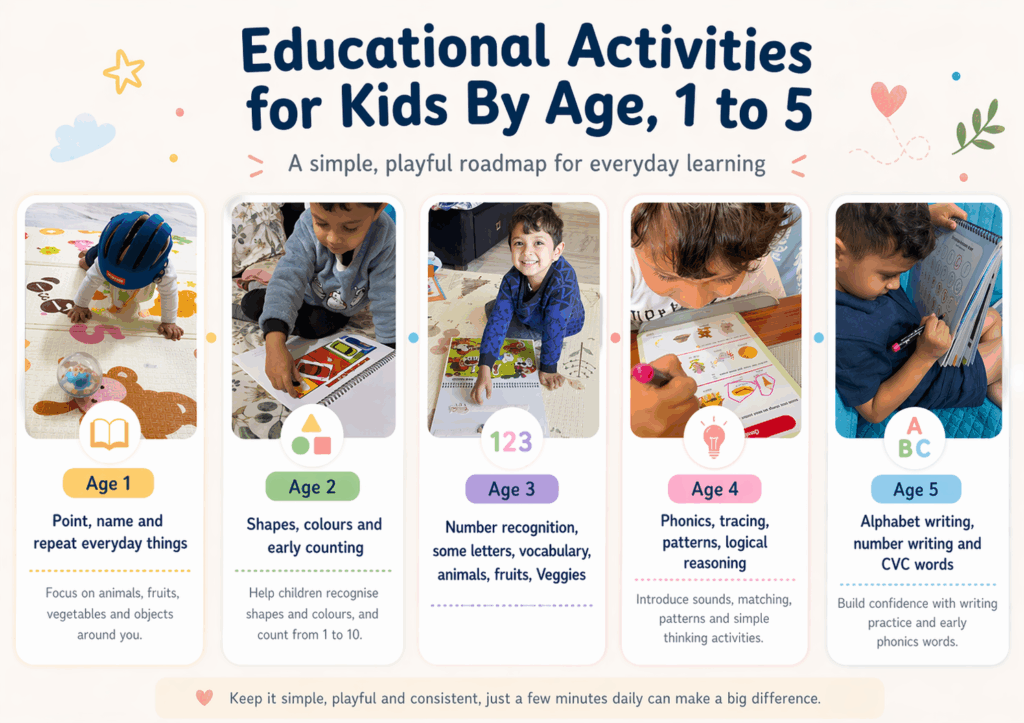
Educational Activities by Age, 1 to 5
Age 1
Point, name, and repeat. Start with the world around your child. Some of the best educational activities at this stage include naming body parts, household objects, fruits, vegetables, animals, and familiar things they see every day.
Age 2
Shapes, colours, matching, and early counting exposure. This is a great age to begin simple educational activities through play. Children can start noticing colours, recognising common shapes, naming animals, fruits, and vegetables, and enjoying early number exposure like counting from 1 to 10.
Age 3
Number recognition, some letters, vocabulary, and simple thinking activities. Many parents begin introducing educational activities around number recognition from 1 to 5, some letter awareness, grouping, and easy matching or problem-solving tasks at this stage.
Age 4
Phonics, tracing, patterns, and logical reasoning. At this age, children are often ready for more structured educational activities that still feel playful. This can include beginning sounds, visual discrimination, tracing, simple pattern work, and reasoning tasks.
Age 5
Alphabet writing, number writing, phonics practice, and CVC words. This stage can include more confidence with letters, numbers, writing practice, and early reading support through phonics and simple word building through age-appropriate educational activities.
How to use this guide at home
The easiest way to use this page is to focus on one age, one concept, and one small daily routine.
For example:
- At age 1, spend a few minutes pointing to and naming things through simple educational activities.
- At age 2, introduce colours and shapes through matching activities.
- At age 3, work on simple number recognition and vocabulary-building activities.
- At age 4, bring in phonics and logical thinking activities.
- At age 5, build confidence with writing and early reading practice.
You do not have to cover everything in one day. A few focused educational activities each day can be far more helpful than a long session once in a while.
Educational Activities for 1 Year Olds
At age 1, learning begins with observation, repetition, and interaction. This is the stage to keep educational activities simple and close to real life.
The CDC also encourages parents at this stage to build learning through daily interaction, such as asking toddlers to find objects, name body parts, and enjoy simple matching games, which makes their toddler development tips for ages 1 to 2 a useful reference for parents starting at home.
Good focus areas include:
- body parts
- animal names
- fruits and vegetables
- toys and household items
- pointing and finding
- hearing words repeated often
You are not trying to “teach lessons” here. You are helping your child connect words with the world around them through simple educational activities and everyday interaction.
Educational Activities for 2 Year Olds
Age 2 is often where educational activities start to become more visible. Children usually enjoy activities that involve recognising, matching, sorting, and naming.
This is a strong stage to introduce:
- basic shapes like circle, square, and triangle
- basic colours
- names of animals, fruits, and vegetables
- matching and sorting
- early counting exposure from 1 to 10
The best educational activities at this age are simple, hands-on, and based on familiar objects. You can create your own folders or check our activity binders (Fruits & Vegetables Activity Binder, Color Recognition Activity Binder, Shapes Activity Book, Animals Activity Binder) for busy parents who need an easy solution and yet a productive time with kids.
Educational Activities for 3 Year Olds
At age 3, many children are ready for slightly more structured educational activities, especially when the tasks still feel playful and visual.
You can begin working on:
- number recognition from 1 to 5
- some letters
- same and different
- grouping by category
- vocabulary building
- simple matching and easy problem solving
This is also a good time to keep revisiting earlier concepts like colours and shapes in new ways through engaging educational activities. We have curated playful activities to keep kids engaged and learn Numbers and Alphabets in a playful manner. Check out our reusable Number Recognition Activities Busy Binder and Alphabet Recognition Activities Binder Book. If you think your child already knows the basics and is looking for screen-free Activity Binders that group all basic concepts and provide fun activities to help kids revisit those concepts and feel confident while doing those activities, then check our All-in-One Activity Binder. It’s our bestseller for this age group. Our new addition is the Premium Busy Binder that includes everything from solar system matching to tracing, sorting, patterns, logic puzzles, and mazes.
Educational Activities for 4 Year Olds
At age 4, many children are ready for more guided educational activities, especially when they are still hands-on and interesting.
This stage can include:
- phonics readiness
- beginning sounds
- tracing
- patterns
- visual discrimination
- logical reasoning activities
The goal is not to make learning harder. The goal is to make educational activities deeper while keeping them engaging. We offer a collection of reusable worksheets designed to keep children engaged while building early learning skills through mazes, number and letter matching, tracing, counting, and I Spy activities. We also have Logical Reasoning Worksheets (Age 3–6), if you really want to give something challenging yet appropriate for their age.
Educational Activities for 5 Year Olds
By age 5, many parents start bringing in more writing and early reading support. This stage can be a natural time to work on confidence and consistency through structured educational activities.
Good focus areas include:
- alphabet writing
- number writing
- phonics practice
- CVC words
- simple worksheets
- pre-reading skills
At this stage, children often benefit from clear structure, repetition, and simple educational activities they can finish successfully. We offer Phonics Worksheets that make it easier for parents to teach phonics in a fun and simple way. We also have Magic Alphabet Flash Cards with Tracing & Numbers (Reusable) – A to Z + 1–9 that bring together number tracing from 1 to 9, small and capital alphabets, and words that begin with each letter sound, all in one place.
A simple home learning routine that works
If you are not sure how to begin, keep it very simple:
- Pick one concept, such as colours, shapes, animals, numbers, or letters.
- Spend 5 to 10 minutes on one short educational activity.
- Talk through the activity instead of just asking for answers.
- Repeat the same idea often before moving to the next one.
This works especially well for young children because repetition builds familiarity, confidence, and memory.
What Educational Activities and Learning Materials Help Most
The best learning materials for young children are usually the ones that make educational activities easy to see, touch, repeat, and understand.
That is why many parents prefer screen-free, hands-on materials that use simple matching, sorting, real-world pictures, and interactive tasks. When educational activities are easy to take out and use for a few minutes, parents are more likely to stay consistent, and children are more likely to stay interested.
That thinking is also behind the binders and worksheets we create at The Toddler Learning. Each one is designed to make early learning simpler for parents and more engaging for children through repetition, hands-on play, and familiar visuals.
Detailed age-wise guides coming next
This page is the main overview. We will also be creating detailed posts for each age group so parents can go deeper into the right educational activities, materials, and teaching ideas for that stage.
- What to Teach a 1 Year Old at Home
- What to Teach a 2 Year Old at Home
- What to Teach a 3 Year Old at Home
- What to Teach a 4 Year Old at Home
- What to Teach a 5 Year Old at Home
Once those posts are ready, this page will link to them so you can move from the broad overview into a more detailed age-specific guide.
Final thoughts
You do not need to do everything at once. Start with what makes sense for your child’s age, keep educational activities simple, and repeat often.
Home learning works best when it feels natural, visual, and easy to continue. The real goal is not perfection. It is helping your child build familiarity, confidence, and curiosity, one small step at a time through meaningful educational activities.
Frequently Asked Questions
What should I teach my child first at home?
Start with simple educational activities that connect to daily life, like naming objects, pointing, matching, colours, shapes, animals, fruits, vegetables, and early number awareness.
How long should home learning be each day?
Short daily sessions usually work best. Even 5 to 10 minutes of focused educational activities can be useful when repeated regularly.
Should I teach colours and shapes before letters?
Many parents begin with colours, shapes, matching, and vocabulary before moving into letters and phonics, especially for younger children.
At what age should I start phonics?
Many parents begin introducing phonics more intentionally around age 4, once children are comfortable with listening, speaking, and basic concept learning.
What should a 5-year-old learn at home?
At age 5, many parents focus on alphabet writing, number writing, phonics practice, CVC words, and early reading readiness through simple educational activities.
What kind of learning material is best for young children?
Simple, hands-on, screen-free materials that use repetition, matching, sorting, and clear visuals tend to be easiest for both parents and children to use consistently.
Not sure where to start? Choose your child’s age and explore our screen-free activity binders designed for simple home learning.
